Surveyor 1: land the first American probe on the Moon
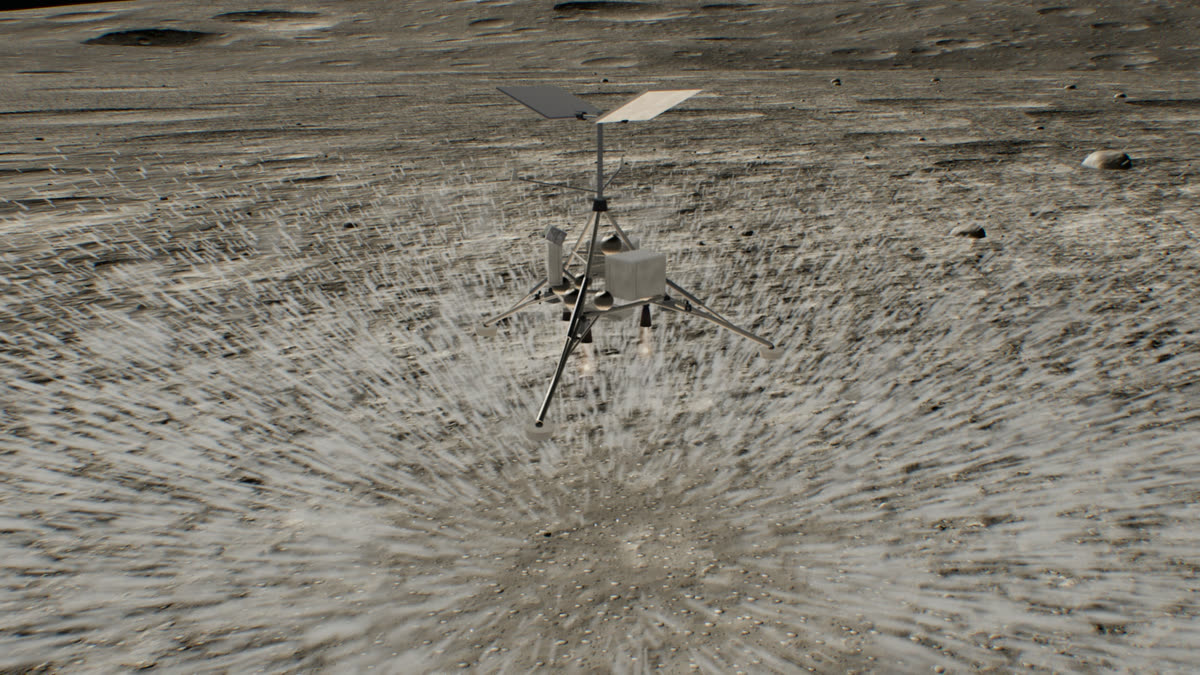
Surveyor 1, 1966 — the first American soft landing on the Moon. It is the first level of Gravity Approach: a three-legged lander that forgives small errors, over a flat lunar plain.
Play Surveyor 1 — free, in the browser
The mission at a glance
- Country
- United States (NASA)
- Launch
- 30 May 1966, Atlas-Centaur
- Landing
- 2 June 1966, at about 3 m/s
- Site
- Ocean of Storms, north of Flamsteed crater
- Mass on the Moon
- about 294 kg
- In the game
- Moon, level 1 — no account needed
What happened in 1966
On 2 June 1966, four months after the Soviet Luna 9, Surveyor 1 became the first American spacecraft to land softly on the Moon, at the first attempt.
Its descent was fully automatic and guided by radar. A solid-fuel retro-rocket, lit 75 km above the surface, did most of the braking; three small throttleable vernier engines then flew the probe down to 3.4 m, where they cut off and let it drop.
Its camera sent back more than 11,000 pictures, which helped choose the Apollo landing sites.
The level in Gravity Approach
The level keeps the vernier descent over a flat plain of the Ocean of Storms, with the crater seen beside the real lander from orbit.
The braking phase flies itself down to 300 m. Then the engine is yours, and so is the landing.
What the game changes
The solid retro-rocket burn and the final free fall from 3.4 m are not flown, and the three vernier engines are merged into one throttleable engine.
How to land Surveyor 1
- Watch the first phase: the probe brakes on its own down to 300 m.
- Then throttle up and down to slow the fall. A steady throttle holds the probe still; more slows the fall, less lets it speed up.
- Get the vertical speed under 5 m/s before 50 m.
- Stay upright: the SAS holds the attitude. Touch down with less than 5° of tilt.
- Slide towards the flag with the RCS thrusters to land inside the zone.
- Keep the engine running until the legs touch: under 3 m/s is safe, about 2 is ideal.
Play Surveyor 1 — free, in the browser
The real Surveyor 1
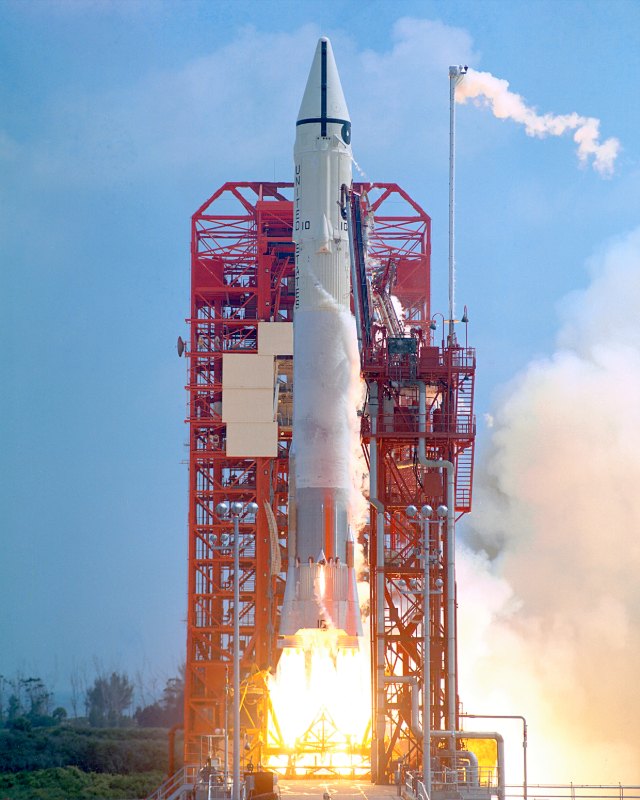
NASA, Public domain, via Wikimedia Commons

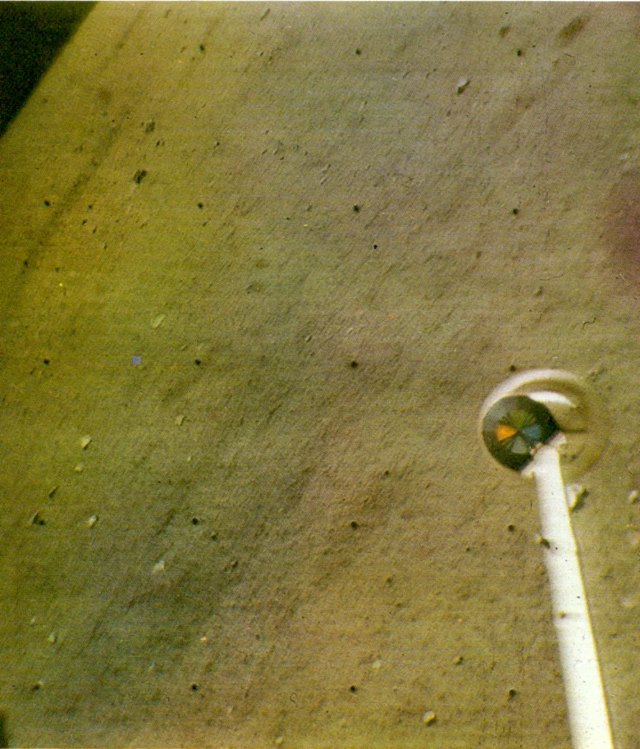
NASA, Public domain, via Wikimedia Commons

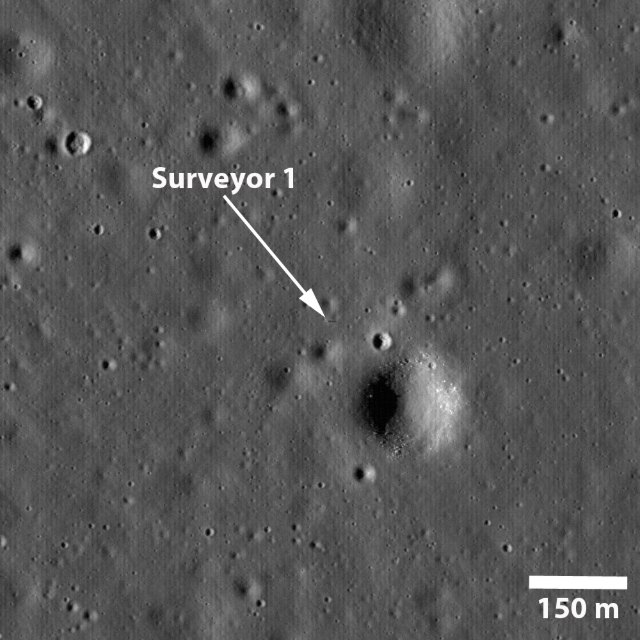
NASA / Lunar Reconnaissance Orbiter, Public domain, via Wikimedia Commons
